


As a reliable supplier of Bromoethane, I've had numerous inquiries about how this compound reacts with carbonyl compounds. In this blog, I'll delve into the chemistry behind these reactions, exploring the mechanisms, products, and practical applications.
Understanding Bromoethane and Carbonyl Compounds
Bromoethane, with the chemical formula (C_{2}H_{5}Br), is an alkyl halide. It is a colorless, volatile liquid with a sweet odor. The carbon - bromine bond in bromoethane is polar due to the difference in electronegativity between carbon and bromine. This polarity makes the carbon atom attached to the bromine susceptible to nucleophilic attack. You can find more information about Bromoethane on our website Bromoethane.
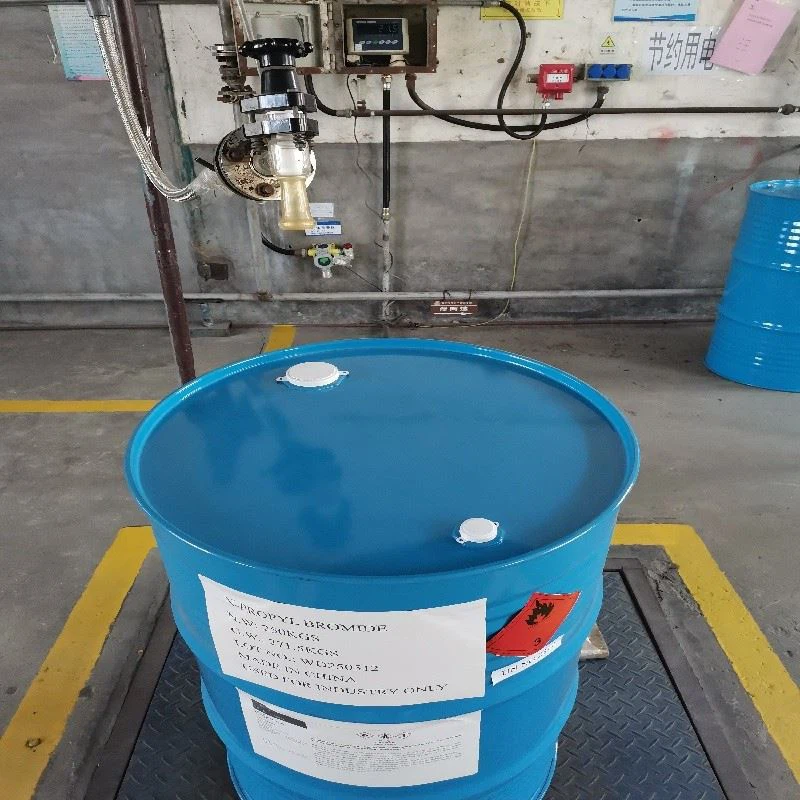

Carbonyl compounds, on the other hand, contain a carbon - oxygen double bond ((C = O)). This functional group is highly polar, with the oxygen atom being more electronegative than the carbon atom. The carbonyl carbon is electrophilic, making it a target for nucleophilic reagents. Common examples of carbonyl compounds include aldehydes ((R - CHO)), ketones ((R - CO - R')), carboxylic acids ((R - COOH)), esters ((R - COOR')), and amides ((R - CONH_{2})).
Reactions of Bromoethane with Carbonyl Compounds
Reaction with Enolate Ions (Aldol - Type Reactions)
When a carbonyl compound has an alpha - hydrogen (a hydrogen atom on the carbon adjacent to the carbonyl group), it can undergo keto - enol tautomerism. In the presence of a base, the enol form can be deprotonated to form an enolate ion. The enolate ion is a strong nucleophile and can react with bromoethane.
Let's take the example of a simple ketone, acetone ((CH_{3}COCH_{3})). In the presence of a base such as sodium hydroxide ((NaOH)), the alpha - hydrogen of acetone can be removed to form the enolate ion ((CH_{3}COCH_{2}^{-})). This enolate ion can then attack the electrophilic carbon in bromoethane.
The reaction mechanism involves the nucleophilic attack of the enolate ion on the carbon atom of bromoethane. The bromide ion ((Br^{-})) is displaced as a leaving group. The overall reaction can be represented as follows:
(CH_{3}COCH_{2}^{-}+C_{2}H_{5}Br\rightarrow CH_{3}COCH_{2}C_{2}H_{5}+Br^{-})
This reaction is an example of an alkylation reaction, where an alkyl group ((C_{2}H_{5})) is added to the carbonyl compound. The product is a substituted ketone.
Reaction with Grignard - Type Reagents Derived from Bromoethane
Bromoethane can be used to prepare Grignard reagents. When bromoethane reacts with magnesium ((Mg)) in anhydrous ether, ethylmagnesium bromide ((C_{2}H_{5}MgBr)) is formed:
(C_{2}H_{5}Br + Mg\xrightarrow{\text{anhydrous ether}}C_{2}H_{5}MgBr)
Ethylmagnesium bromide is a strong nucleophile. When it reacts with a carbonyl compound, such as an aldehyde or a ketone, it forms an alcohol after hydrolysis.
For example, when ethylmagnesium bromide reacts with formaldehyde ((HCHO)):
- Nucleophilic attack: (C_{2}H_{5}MgBr + HCHO\rightarrow C_{2}H_{5}CH_{2}OMgBr)
- Hydrolysis: (C_{2}H_{5}CH_{2}OMgBr + H_{2}O\rightarrow C_{2}H_{5}CH_{2}OH+Mg(OH)Br)
The product is 1 - propanol. If the carbonyl compound is a ketone, a secondary alcohol is formed. For instance, when ethylmagnesium bromide reacts with acetone ((CH_{3}COCH_{3})):
- Nucleophilic attack: (C_{2}H_{5}MgBr+CH_{3}COCH_{3}\rightarrow (CH_{3}){2}C(OC{2}H_{5})MgBr)
- Hydrolysis: ((CH_{3}){2}C(OC{2}H_{5})MgBr + H_{2}O\rightarrow (CH_{3}){2}CHC{2}H_{5}OH+Mg(OH)Br)
The product is 2 - methyl - 2 - butanol, a secondary alcohol.
Reaction with Carboxylic Acids and Esters
Bromoethane can react with carboxylate anions, which are formed when carboxylic acids are deprotonated by a base. The reaction is similar to the reaction with enolate ions.
For example, if sodium acetate ((CH_{3}COO^{-}Na^{+})) reacts with bromoethane:
(CH_{3}COO^{-}+C_{2}H_{5}Br\rightarrow CH_{3}COOC_{2}H_{5}+Br^{-})
The product is ethyl acetate, an ester. This reaction is an example of an esterification reaction using an alkyl halide.
Practical Applications of These Reactions
The reactions between bromoethane and carbonyl compounds have several practical applications in the chemical industry and organic synthesis.
Pharmaceutical Synthesis
Many pharmaceutical compounds contain carbon - carbon bonds that can be formed through the reactions described above. For example, the synthesis of certain anti - inflammatory drugs may involve the alkylation of a carbonyl compound using bromoethane. The ability to introduce specific alkyl groups to carbonyl compounds allows chemists to design and synthesize molecules with desired biological activities.
Polymer Synthesis
In polymer chemistry, the reactions of bromoethane with carbonyl compounds can be used to modify polymer chains. For example, the reaction of an enolate - containing polymer with bromoethane can introduce new functional groups to the polymer, altering its physical and chemical properties.
Flavor and Fragrance Industry
The synthesis of flavor and fragrance compounds often involves the formation of carbon - carbon bonds. The reactions between bromoethane and carbonyl compounds can be used to create new and unique odorants. For example, the synthesis of certain esters, which are commonly used in the flavor and fragrance industry, can be achieved through the reaction of a carboxylate anion with bromoethane.
Safety Considerations
Bromoethane is a toxic and flammable compound. It can cause irritation to the skin, eyes, and respiratory tract. Inhalation of bromoethane vapors can lead to headaches, dizziness, and in severe cases, damage to the central nervous system. When handling bromoethane, appropriate safety measures should be taken, including the use of personal protective equipment such as gloves, goggles, and a fume hood.
Carbonyl compounds also have their own safety hazards. Aldehydes and ketones are flammable, and some are toxic. Carboxylic acids can be corrosive, and esters can have irritating properties. It is essential to follow safety guidelines when working with these compounds.
Conclusion
The reactions between bromoethane and carbonyl compounds are diverse and have significant importance in organic synthesis and various industries. Whether it's the formation of new carbon - carbon bonds through enolate alkylation or the synthesis of alcohols and esters using Grignard reagents, these reactions offer a wide range of possibilities for chemists.
As a supplier of high - quality Bromoethane, we understand the importance of providing a reliable source of this compound for your chemical reactions. If you are interested in purchasing bromoethane for your research or industrial applications, we invite you to contact us for a detailed discussion about your requirements and to explore the potential of these reactions in your projects. You can also learn more about related bromine - containing compounds such as Hydrobromic Acid on our website.
References
- Smith, M. B., & March, J. (2007). March's Advanced Organic Chemistry: Reactions, Mechanisms, and Structure. John Wiley & Sons.
- Carey, F. A., & Sundberg, R. J. (2007). Advanced Organic Chemistry Part A: Structure and Mechanisms. Springer.
- Clayden, J., Greeves, N., Warren, S., & Wothers, P. (2012). Organic Chemistry. Oxford University Press.


