


Hey there! I'm a supplier of Bromoethane, and today I wanna dive into how bromoethane reacts with a thiol. It's a pretty interesting topic, and I hope by the end of this blog, you'll have a good understanding of the reaction and maybe even consider getting in touch for some bromoethane for your own experiments or projects.

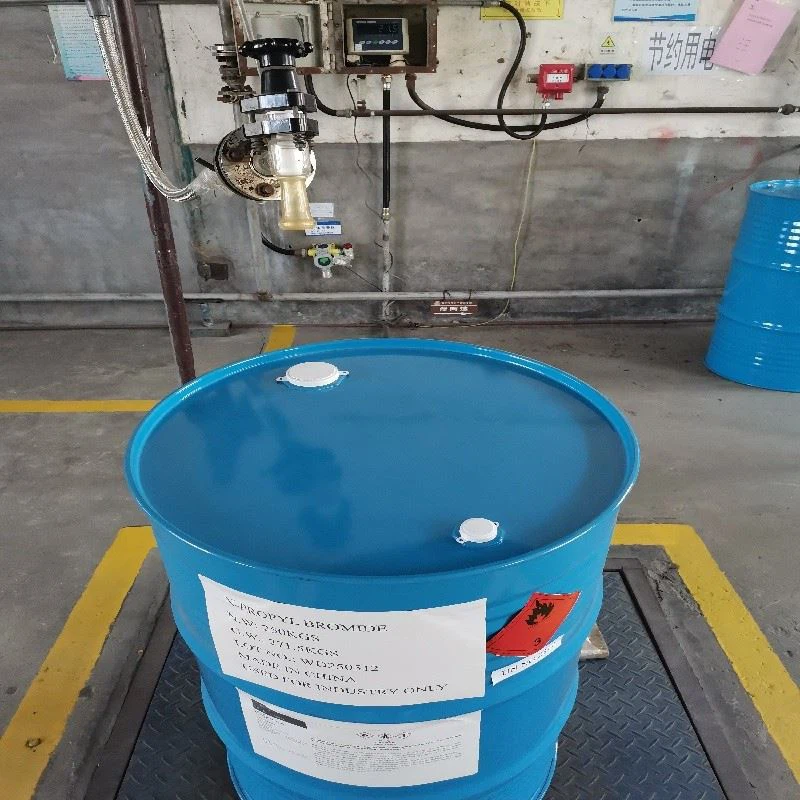
First off, let's talk a bit about bromoethane. Bromoethane, as you can find out more about here, is an organic compound with the formula C₂H₅Br. It's a colorless, volatile liquid with a sweetish odor. It's commonly used in organic synthesis, and one of the reactions it can undergo is with thiols.
Thiols, also known as mercaptans, are organic compounds that contain a sulfur - hydrogen (S - H) bond. They have a distinct, often unpleasant smell, kind of like rotten eggs. But don't let the smell fool you; they're quite useful in chemistry.
So, how do bromoethane and a thiol react? Well, it's a classic nucleophilic substitution reaction. In this reaction, the thiol acts as a nucleophile. A nucleophile is basically a species that has a pair of electrons it can donate to form a new chemical bond. The sulfur atom in the thiol has a lone pair of electrons, and it's attracted to the partially positive carbon atom in bromoethane.
The carbon - bromine bond in bromoethane is polar because bromine is more electronegative than carbon. This means that the bromine atom pulls the electrons in the bond towards itself, leaving the carbon atom with a partial positive charge (δ⁺). The sulfur atom in the thiol, with its lone pair, attacks this partially positive carbon atom.
When the sulfur atom attacks the carbon atom, a new bond forms between the sulfur and the carbon. At the same time, the carbon - bromine bond breaks, and the bromine atom leaves as a bromide ion (Br⁻). The overall reaction can be written as:
C₂H₅Br + RSH → C₂H₅SR + HBr
Here, R represents an alkyl or aryl group in the thiol. So, what we end up with is an alkyl sulfide (C₂H₅SR) and hydrobromic acid (HBr). You can learn more about hydrobromic acid on the provided link.
Let's break down the steps of this reaction a bit more. First, the thiol exists in an equilibrium with its conjugate base, the thiolate anion (RS⁻). In the presence of a base, the equilibrium can shift towards the formation of more thiolate anions. The thiolate anion is an even better nucleophile than the neutral thiol because it has a full negative charge on the sulfur atom.
The reaction mechanism can be described as an SN₂ (substitution nucleophilic bimolecular) reaction. In an SN₂ reaction, the nucleophilic attack and the leaving group departure happen simultaneously. The transition state in this reaction has a pentacoordinate carbon atom, with the incoming sulfur atom and the departing bromine atom both partially bonded to the carbon.
The rate of this reaction depends on a few factors. One of the main factors is the concentration of the reactants. According to the rate law for an SN₂ reaction, the rate is proportional to the concentration of both the bromoethane and the thiol (or thiolate anion). So, if you increase the concentration of either reactant, the reaction will go faster.
Another factor is the nature of the thiol. Thiols with more electron - donating groups attached to the sulfur atom are better nucleophiles. This is because the electron - donating groups increase the electron density on the sulfur atom, making it more likely to attack the carbon atom in bromoethane.
The solvent also plays a role. Polar aprotic solvents are often preferred for SN₂ reactions. These solvents can solvate the cations (like the counter - ion of the thiolate anion if it's formed) but don't solvate the nucleophile (the thiolate anion) too strongly. This leaves the nucleophile more available to attack the substrate (bromoethane).
Now, let's talk about some practical applications of this reaction. The formation of alkyl sulfides is important in organic synthesis. Alkyl sulfides can be used as intermediates in the synthesis of more complex organic compounds. For example, they can be oxidized to form sulfoxides and sulfones, which have various applications in the pharmaceutical and materials industries.
In the pharmaceutical industry, sulfoxides and sulfones are used in the synthesis of drugs. They can have biological activities themselves, such as anti - inflammatory and antibacterial properties. In the materials industry, they can be used in the production of polymers and other materials with specific properties.
As a bromoethane supplier, I know that this reaction is just one of the many ways bromoethane can be used. It's a versatile compound, and if you're involved in organic synthesis, it could be a valuable addition to your chemical inventory.
If you're interested in using bromoethane for your own projects, whether it's for this reaction with thiols or other applications, I'd love to hear from you. You can reach out to discuss your requirements, and we can have a chat about how we can work together to get you the bromoethane you need.
To sum it up, the reaction between bromoethane and a thiol is a nucleophilic substitution reaction that results in the formation of an alkyl sulfide and hydrobromic acid. It's an important reaction in organic synthesis with various practical applications. And if you're in the market for bromoethane, don't hesitate to get in touch.
References
- Carey, F. A., & Sundberg, R. J. (2007). Advanced Organic Chemistry: Part A: Structure and Mechanisms. Springer.
- March, J. (1992). Advanced Organic Chemistry: Reactions, Mechanisms, and Structure. Wiley.


