


As a supplier of Bromoethane, I often encounter various technical inquiries from customers. One question that has come up quite frequently is: "How many pi bonds are there in bromoethane?" In this blog post, I'll delve into the molecular structure of bromoethane to answer this question and provide some related insights.
Molecular Structure of Bromoethane
Bromoethane, with the chemical formula (C_{2}H_{5}Br), is an alkyl halide. To understand the number of pi bonds in bromoethane, we first need to analyze its Lewis structure and the types of bonds present.
The Lewis structure of bromoethane is based on the valence electrons of each atom. Carbon has 4 valence electrons, hydrogen has 1 valence electron, and bromine has 7 valence electrons. In bromoethane, there are two carbon atoms, five hydrogen atoms, and one bromine atom.
The carbon - carbon bond in bromoethane is a single bond. A single bond is a sigma ((\sigma)) bond, which is formed by the head - on overlap of atomic orbitals. Each carbon - hydrogen bond is also a single ((\sigma)) bond, resulting from the overlap of a carbon orbital and a hydrogen orbital. The carbon - bromine bond is also a single ((\sigma)) bond.
Pi ((\pi)) bonds, on the other hand, are formed by the side - by - side overlap of p - orbitals. Pi bonds are typically found in double or triple bonds. A double bond consists of one (\sigma) bond and one (\pi) bond, while a triple bond consists of one (\sigma) bond and two (\pi) bonds.
In the case of bromoethane, the entire structure is composed of single bonds. There are no double or triple bonds present in the (C_{2}H_{5}Br) molecule. Therefore, the number of pi bonds in bromoethane is 0.
Understanding the Significance of Bond Types
The nature of the bonds in a molecule has a significant impact on its chemical and physical properties. Sigma bonds are stronger than pi bonds because the head - on overlap in (\sigma) bonds allows for more effective orbital interaction. This makes single - bonded molecules like bromoethane relatively stable compared to molecules with multiple bonds.

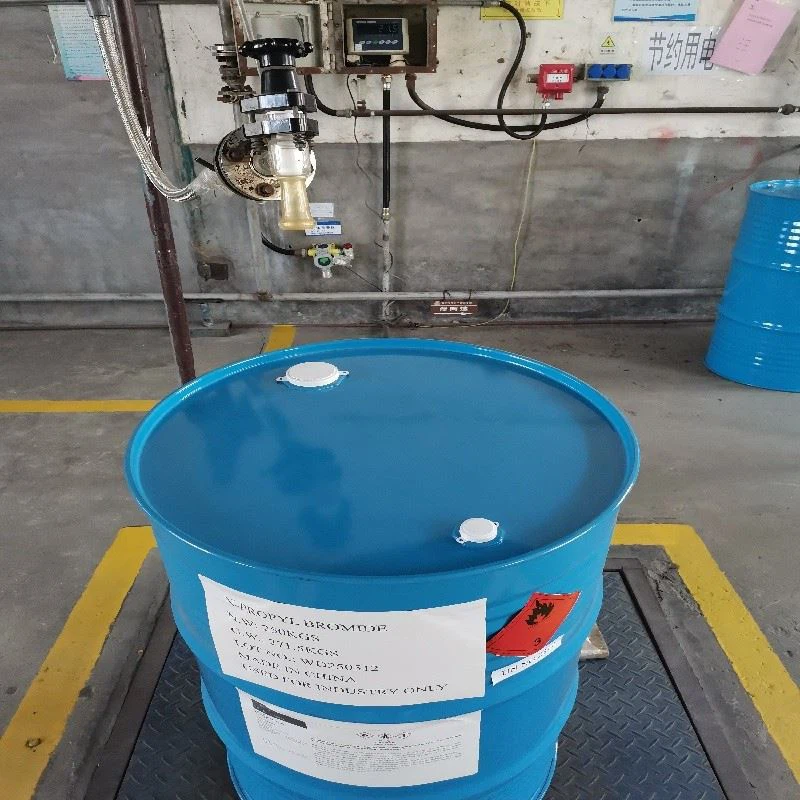
Bromoethane's single - bond structure gives it certain reactivity patterns. For example, it can undergo substitution reactions where the bromine atom is replaced by another functional group. The lack of pi bonds also means that bromoethane does not participate in addition reactions, which are characteristic of molecules with double or triple bonds.
Applications of Bromoethane
Bromoethane has a wide range of applications in various industries. In the pharmaceutical industry, it is used as an intermediate in the synthesis of many drugs. It can also be used in the production of pesticides and dyes.
In the laboratory, bromoethane is a useful reagent for introducing an ethyl group into a molecule. This process, known as ethylation, is important in organic synthesis.
Related Compounds and Their Bonding
To further understand the concept of pi bonds, it's helpful to compare bromoethane with some related compounds. For example, ethene ((C_{2}H_{4})) has a carbon - carbon double bond. This double bond consists of one (\sigma) bond and one (\pi) bond. The presence of the pi bond makes ethene more reactive than bromoethane. Ethene can undergo addition reactions with substances like hydrogen, halogens, and water.
Another related compound is ethyne ((C_{2}H_{2})), which has a carbon - carbon triple bond. A triple bond contains one (\sigma) bond and two (\pi) bonds. Ethyne is even more reactive than ethene due to the presence of two pi bonds.
Hydrobromic Acid and Bromoethane Production
Hydrobromic Acid is an important precursor in the production of bromoethane. The reaction between ethanol and Hydrobromic Acid can produce bromoethane. This reaction is an example of a substitution reaction, where the hydroxyl group ((-OH)) in ethanol is replaced by a bromine atom.
The reaction equation is as follows:
(C_{2}H_{5}OH + HBr\rightarrow C_{2}H_{5}Br + H_{2}O)
This reaction is typically carried out in the presence of a catalyst to increase the reaction rate.
Our Bromoethane Product
As a Bromoethane supplier, we are committed to providing high - quality bromoethane to our customers. Our product is produced through a strict manufacturing process to ensure its purity and quality. We have a team of experienced chemists and technicians who monitor every step of the production process to meet the highest industry standards.
We understand the importance of bromoethane in various applications, and we strive to provide our customers with the best - suited product for their needs. Whether you are in the pharmaceutical, pesticide, or dye industry, our bromoethane can be a valuable addition to your production process.
Contact Us for Purchase
If you are interested in purchasing bromoethane for your business, we invite you to contact us for further discussions. We can provide you with detailed product information, pricing, and delivery options. Our sales team is always ready to assist you in finding the best solution for your needs.
References
- Organic Chemistry, 9th Edition, Paula Yurkanis Bruice
- Chemical Principles: The Quest for Insight, 6th Edition, Peter Atkins and Loretta Jones


